
FAQ

We've put together some frequently asked questions to provide you more information about Parcel Funders and the services we offer. If you need further help, please contact us.

General

A direct funder funds transactions from their own private capital. Meaning there isn’t a 3rd party (broker/middleman) involved with your transaction, reducing your out of pockets cost. Direct funders also approve all loans internally allowing for a quick closing. Parcel Funders is a direct funder.
We can usually underwrite and fund a land deal within 48 hours or less.

We fund land deals nationwide (50 states and D.C.).

Depending on the property, price, and location, we'll consider land deals that do not fit this criteria.


Property Type: Beachfront, Commercial, Farm, Horse, Hunting, Lakefront, Ranch, Recreational, Residential, Riverfront, Timberland, Undeveloped, Waterfront
Location: United States
Lot Size: 5,000 SF or Larger
Legal Access: Yes
Wetlands: Yes
Floodplain: Yes
Max Funding Amount: $1M (No Minimum)
Purchase Price: 50% or Less of Market Value
Sale Time: 12 Months or Less
Sale Terms: Cash/Seller Financing

We don't run credit or background checks on our investors as a prerequisite to offering transactional or joint venture funding.

We don't have a minimum funding amount and we have a maximum amount of $1,000,000.

We offer a free Proof of Funds letter to our investors on bank letterhead. Please contact us and we'll email you the letter in PDF format for your specific property.

We'll review your deal within 24 hours, but it's usually within the same day. After our initial review, we'll reach out to you with any questions and next steps.

Yes, we can fund multiple parcels at one time and we're okay with selling them separately.

We can fund up to $1,000,000 and there are no limitations to the number of deals that you can do through us. If your land investment meets our general requirements, we'll fund it for you. However, transactions over $250,000 are given special consideration and handled on a case-by-case basis.

Generally, we'll fund option payments, down payments, and earnest money, but each deal will be handled on a case-by-case basis.

While other funders may openly share information about the deals they have funded, we absolutely do not. Our funding agreement includes non-disclosure language that bars us from discussing your deal with anyone else.

No. We’ve fine-tuned our process so you can request funds through our online service. We make it fast and simple to use and all signatures can be completely through digital signature, fax or by printing, signing, and then scanning and emailing the forms back to us.

Yes, we require each deal to go through a title company or title attorney and that the same one be used on both the buy and sale side of the transaction.

Yes, we require that you have a signed purchase and sales agreement (PSA) prior to requesting funding for a land deal.

Yes, but it's on a case-by-case basis.

We don't have income requirements for our investors as we're an asset-based funder.

It's helpful if you under the basics of land investing, but we do fund new land investors without having done a deal.

No, we cover all closing costs so the investor doesn't have to come out of pocket for any fees related to the purchase and sale of the property.

No, an appraisal is not required. We will underwrite your deal in-house and get you a funding commitment within 48 hours.

Transactional Funding

Transactional funding is a method of supplying money for an investor’s purchase of a property which has already been resold to an end-buyer. The money is usually used for less than a complete day as the investor closes with the seller and later in the day his end-buyer closes.

A double closing is defined as the closing of the purchase and sale of a property twice in the same day. The end-buyer can close first or second, but the original seller must close the same day to be able to use transactional funding. If the A – B “leg” closes on one day and the B – C leg closes another day, “extended” transactional funding is required. This extended use of the money will often be a hard money loan and will usually need a mortgage and note to secure the lender’s money.

Step 1: Investor/Buyer B signs agreement to buy property from Seller A for $30,000.

Step 2: Buyer C signs an agreement to purchase the property from Investor B for $50,000, typically closing on the same day Investor B is buying from Seller A.

Step 3: The closing agent confirms that its office has received Buyer C’s funds for C’s purchase from Investor B. The closing agent then gives Parcel Funders transactional funding approval.

Step 4: Parcel Funders wires total of funds needed for Investor B’s purchase. Investor B uses funds to buy property from Seller A. Shortly after, Investor B sells the property to Buyer C.

Step 5: Investor B uses the money from the sale to pay back Parcel Funder and funding fee and keeps the remaining money as profit.
Our investors use our transactional funding service for three basic reasons:

1. They have a contract that is not assignable to a third party. This is typical when purchasing land off the MLS, bank owned properties, or properties owned by government entities (HUD, FHA, Fannie Mae, etc.).
2. The investor is choosing not to assign the contract in order to maximize their wholesale markup. Many times end buyers will not purchase a property if the assignment fee is too high. You do not have to disclose your contract details to the end buyer when you utilize transactional funding.
3. The investor needs to stay in compliance with state laws that do not allow assignment of contracts..

We charge 3% of the acquisition price of the property ($3,000 minimum fee), and there are no upfront or additional fees if the transaction does not close charged by us. In addition, we require you to pay for Lender's Title Insurance and a Lender's Closure Protection Letter. These are standard lender fees.

We require the following documents from all principals of the borrower: the A to B Contract, the B to C Contract, government ID, closing firm details (contact name, phone, and email) and if applicable, corporate documents (operating agreement, articles of organization, and EIN letter). In addition, if the C Buyer (end buyer) is getting a loan to purchase the property, please send all lender information (contact name, phone, email, pre-approval letter, term sheet, short sale approval letter, HUD/REO acceptance letter, etc.). If you're buying in a trust, we'll need the the Agreement and Declaration of the trust, the Appointment of Trustee, Assignment of Beneficial Interest, the Affidavit of Trust, and the Deed to Trustee. We are the last money in and the first money out. Therefore, we fund once we have confirmed both sides have signed and the end buyer's funds have been placed with the title attorney or company.

We require both the A-B and the B-C transactions occur at the same title attorney or title company. Some exceptions are possible, so please discuss your specific situation with us if you'd like the transactions to close at different offices.

While this doesn’t happen very often, it is always a threat. If the end-buyer decides not to close, the end-buyer risks their earnest money deposit (EMD). The result is the investor will also likely lose their EMD. The investor may also lose the deal unless the transactional funder is willing to “convert” the closed A – B transaction to a joint venture transaction. The best way to head-off this undesirable possibility is to have the closing agent, and yourself, stay in touch with your end-buyer to alert him/her to what is happening and how soon he/she needs to be ready to wire their money. Also, a good preventative measure is to get the end-buyer a Preliminary HUD-1 Closing Statement at least a few days before closing.
No. We only fund you, the B investor, for the A-B closing. Your end buyer for the B-C closing must have pre-approval for financing from a certified lender or provide proof of funds if he/she is a cash buyer.

Joint Venture Funding

Joint venture funding is when a real estate investor approaches an individual or company to fund the purchase of a property. Each of the parties retain their existing business identities and they work together to acquire a property. Each party has their own set of responsibilities and how they are assigned depends largely on their expertise, resources, and experience. The profits vary depending on the agreement made between the individual entities, which is based upon their relative contributions.
One of our land investors reached out to us with their due diligence info on a property they had under contract. The purchase was around $9,000. We took less than a day to review the deal and replied back to the investor with our approval. We signed a joint venture funding agreement (investor and Parcel Funders) and then the investor reached out to the title company via email and cc'd us on it. The title company sent over the wire info and we verified it over the phone. Then, we wired the funds for the acquisition amount and title costs. After closing on the deal, Parcel Funders was recorded on the deed and both the investor and us were given digital and hard copy copies of all the paperwork from the title company. Then, the land investor started marketing the property to sell. Within two months, the land investor reached out to us and let us know that we received an offer on the property and we agreed to move forward with the offer. At that point, we signed any necessary paperwork via DocuSign and then we shared this contract with the same title company. The title company received our profit percentage split and they disbursed the funds according to our ownership percentages at time of closing. We sold the property for around $24,000 and netted around $13,000. Parcel Funders received 35% of the $13,000 and the investor took 65% of the $13,000.
A partnership involves the formation of a new, shared legal entity, whereas parties in a joint venture can retain their separate legal status.

The property has to be worth at least $10,000 for us to consider funding the land deal.

We require a minimum net profit of $7,500 for us to consider funding the land deal.

You will have 12 months to sell the property. In the event that you are unable to market and obtain a buyer for the property during this time, then we shall have the right to either sell the property or sell through any third party without paying you any portion of the net profit from the deal.

Yes, we're willing to sell the property on terms, but 100% of the money paid by the buyer for the property must be paid to Parcel Funders until the cost of acquiring the property is satisfied. This includes the original purchase price, property owner’s association dues, property taxes, property liens, closing costs, and any other costs related to purchasing the property. Parcel Funders will be recapitalized within six  months or less of the acquisition settlement date. Then, we and the investor will divide the net proceeds of sale according to our agreed upon profit split percentage.

Depending on the length and success rate of our funding relationship, we provide funding for marketing to off market sellers to acquire their land.

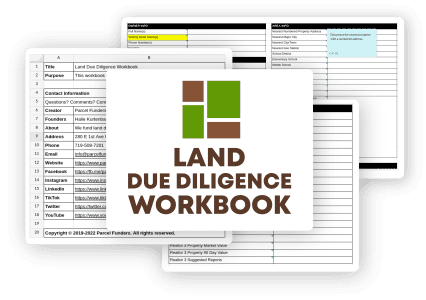
Turnkey Funding

Turnkey funding combines our land investment knowledge and financing ability as a funder with the investor's contribution in the form of the land deal with the goal of making a profit upon resale of the property. In addition to funding 100% of the deal, we'll also oversee the marketing and sale of the property.
A land investor contacted us with their due diligence info on a parcel of land they had under contract. The purchase was approximately $15,000. It took us a few hours to review the deal and we replied back to the investor with our funding approval. We signed a turnkey funding agreement (investor and Parcel Funders) and then the investor reached out to the title company via email and cc'd us on it. The title company sent over the wire info and we verified it over the phone. Then, we wired the funds for the acquisition amount and title costs. After closing on the deal, Parcel Funders was recorded on the deed and both the investor and us were given digital and hard copy copies of all the paperwork from the title company. Then, we started marketing the property to sell it. Within 45 days, we reached out to the investor and let them know that we received an offer on the property and we agreed to move forward with the offer. At that point, we signed the necessary paperwork via DocuSign and then we shared the purchase and sale contract with the same title company. The title company received our profit percentage split and they disbursed the funds according to our ownership percentages at time of closing. We sold the property for around $60,000 and netted around $40,000. Parcel Funders received 55% of the $40,000 and the investor took 45% of the $40,000.
The property has to be worth at least $10,000 for us to consider funding the land deal.
We require a minimum net profit of $7,500 for us to consider funding the land deal.
We will have 12 months to sell the property. After 12 months, the investor and Parcel Funders will be able to jointly market the property.
Yes, we're willing to sell the property on terms, but 100% of the money paid by the buyer for the property must be paid to Parcel Funders until the cost of acquiring the property is satisfied. This includes the original purchase price, property owner’s association dues, property taxes, property liens, closing costs, and any other costs related to purchasing the property. Parcel Funders will be recapitalized within six  months or less of the acquisition settlement date. Then, we and the investor will divide the net proceeds of sale according to our agreed upon profit split percentage.
Depending on the length and success rate of our funding relationship, we provide funding for marketing to off market sellers to acquire their land.
In order to ensure that the property obtains maximum exposure, we will list your property on one or more of the following services: CityFeet, Craigslist, Crexi, eBay, Estately, Facebook, FSBO, HomeSnap, LakeHouse, Land and Farm, Land Broker MLS, Land Century, LandFlip, LandHub, Lands of America, LandLeader, Land-Listings, LandPin, LandSearch, LandWatch, LDCRE, local multiple listing service(s) (MLS), Loopnet, LotNetwork, Movoto, OfferUp, Prime Land Exchange, Realtor, Redfin, Rural Vacant Land, Trulia, Xome, and Zillow. In addition, we'll market your property to our buyers list made up of more than 3,000 people.